
Mammalian genomes contain a diverse array of noncoding RNAs that play essential roles in regulating gene expression. Among these are vault RNAs (vtRNAs), a family of small noncoding RNAs implicated in processes including mRNA splicing, drug resistance, and tumorigenesis. Despite their growing importance in human health and disease, their role within the intestinal epithelium has remained poorly understood.
The intestinal epithelium serves as a critical barrier between the body and the external environment, protecting against pathogens, toxins, and harmful substances. This protective function relies on tight junctions (TJs) and adherens junctions (AJs), which maintain epithelial integrity. When these structures are compromised, intestinal permeability increases, allowing bacteria and toxic molecules to enter the circulation and potentially contribute to infection, inflammation, and sepsis.
Researchers led by Professor Jian-Ying Wang at the University of Maryland School of Medicine have focused their efforts on understanding the role of vtRNA2-1, a vault RNA whose expression is influenced by promoter methylation and has been associated with a variety of diseases. Their recent work demonstrates that vtRNA2-1 expression is significantly altered in the intestinal mucosa under stress conditions, particularly in patients with inflammatory bowel disease (IBD). Their findings identify vtRNA2-1 as a key regulator of intestinal barrier function and a potential therapeutic target for gastrointestinal disorders.
vtRNA2-1 and intestinal barrier function
Previous research had shown that vtRNA expression increases during intestinal stress, but the biological consequences were not fully understood. Through a combination of cellular, organoid, animal, and patient-based studies, the researchers explored how vtRNA2-1 influences gut epithelial integrity.
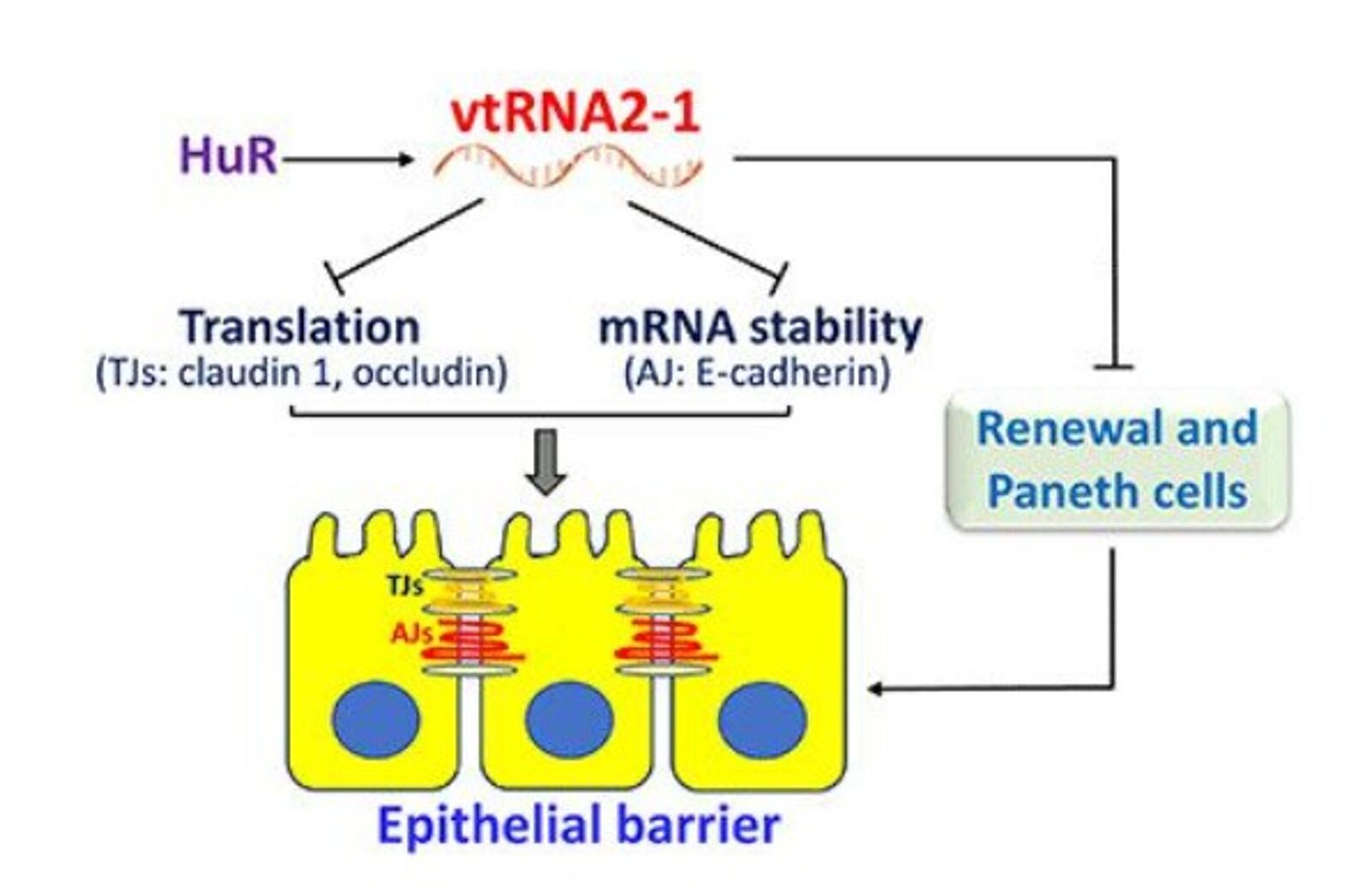
Figure 1. Graphical summary illustrating how vault RNA2-1 (vtRNA2-1) impairs intestinal epithelial barrier function through interaction with the RNA-binding protein HuR. Elevated vtRNA2-1 reduces the expression of tight junction proteins (claudin-1 and occludin) and the adherens junction protein E-cadherin, disrupts epithelial renewal, and compromises gut barrier integrity. Adapted from Ma et al. (2023), EMBO Reports, 24(2), e54925.
Key findings
Stress Increases vtRNA Expression
Expression of vtRNAs within the intestinal epithelium was found to increase under stress conditions. This effect was observed in mouse models of colitis and septic stress, as well as in intestinal tissue samples from patients with active inflammatory bowel diseases, including ulcerative colitis and Crohn's disease.
These observations suggest that vtRNAs, particularly vtRNA2-1, may contribute to disease progression and epithelial dysfunction in IBD.
vtRNA2-1 Weakens the Intestinal Barrier
In vitro experiments demonstrated that elevated vtRNA2-1 levels reduce the expression of key proteins responsible for maintaining epithelial integrity, including:
- Claudin-1
- Occludin
- E-cadherin
Because these proteins are essential components of tight and adherens junctions, their reduction led to increased epithelial permeability and impaired barrier function.
Organoid Studies Confirm Barrier Disruption
Using ex vivo intestinal organoid models, the researchers confirmed that vtRNA2-1 overexpression disrupts the expression of claudin-1, occludin, and E-cadherin. Elevated vtRNA2-1 levels also impaired the function of secretory Paneth cells, which are important for maintaining intestinal homeostasis and antimicrobial defense.
These findings further support the role of vtRNA2-1 in compromising epithelial health and resilience.
Animal Studies Reveal Increased Vulnerability to Stress
To investigate vtRNA2-1 function in vivo, the researchers generated mouse models with elevated vtRNA2-1 expression. Increased vtRNA2-1 levels made the intestinal barrier more susceptible to septic stress, resulting in greater permeability and impaired barrier protection.
In addition, vtRNA2-1 overexpression inhibited growth of the small intestinal mucosa, particularly within proliferating crypt cell populations, suggesting a role in regulating epithelial renewal and regeneration.
HuR Interaction Underlies the Mechanism
Mechanistic studies revealed that vtRNA2-1 regulates intestinal barrier proteins at the post-transcriptional level.
The researchers found that vtRNA2-1:
- Reduces the stability of E-cadherin mRNA.
- Inhibits translation of claudin-1 and occludin without altering their mRNA stability.
- Interferes with the activity of HuR, an RNA-binding protein that normally promotes expression of these barrier-associated genes.
By preventing HuR from binding to its target mRNAs, vtRNA2-1 suppresses the production of proteins required for maintaining epithelial integrity, ultimately weakening the gut barrier.
Implications for inflammatory bowel disease
The work conducted by Professor Wang and colleagues identifies vtRNA2-1 as a central regulator of intestinal epithelial barrier function during inflammatory and stress-related conditions. Through its interaction with HuR and its effects on critical junctional proteins, vtRNA2-1 contributes directly to increased intestinal permeability and impaired mucosal integrity.
The observation that vtRNA2-1 levels are elevated in patients with inflammatory bowel disease suggests that this noncoding RNA may represent a promising therapeutic target for preserving gut barrier function and reducing disease-associated tissue damage.
As understanding of noncoding RNAs continues to grow, studies such as this highlight the potential of vtRNAs as important regulators of intestinal health and as future targets for therapeutic intervention in IBD and other gastrointestinal disorders.
Supplier

GenTarget
GenTarget is a specialist provider of viral vector technologies, with a comprehensive portfolio of lentiviral vectors, adenoviral vectors, reporter systems and custom gene delivery services. The company helps researchers simplify gene expression, gene silencing, genome editing and cell engineering workflows across basic research and translational applications.