
What is the Gut Microbiome Standard?
The Gut Microbiome Standard is a defined microbial community designed to replicate the composition of the human gut microbiome, supporting accuracy, reproducibility, and comparability in gut microbiome workflows. With a known composition and characterised relative abundances, it provides a reliable reference for evaluating performance across DNA extraction, library preparation, sequencing, and bioinformatic analysis.
Applications in the gut microbiome research workflow
The Gut Microbiome Standard can be integrated throughout the workflow to support:
- Method evaluation and optimisation: benchmark extraction and sequencing approaches against a known community
- Quality control: monitor consistency across runs, instruments, and operators
- Bias identification: detect taxon-specific over- or under-representation introduced during processing
- Bioinformatic validation: assess the accuracy of taxonomic classification and relative abundance estimates
Product highlights
- True-to-life composition: contains 21 distinct strains to closely reflect the human gut microbiome.
- Precisely defined: enables reliable benchmarking and validation of next-generation sequencing (NGS) microbiome workflows.
- Cross-kingdom coverage: incorporates Bacteria, Fungi, and Archaea.
| Cat-No. | Item | Size | Price (CHF) |
|---|---|---|---|
| D6331 | ZymoBIOMICS Gut Microbiome Standard | 10 preparations | 519.00 |
Technical specifications
| Biosafety | BSL 1. Microbes have been fully inactivated. |
| Impurity level | < 0.01% foreign microbial DNA |
| Reference genomes | 16S&18S rRNA genes, https://s3.amazonaws.com/zymo-files/BioPool/D6331.refseq.zip |
| Relative-abundance deviation | <15% |
| Storage solution | 2X DNA/RNA Shield (Cat. No. R1200-125). |
| Total cell concentration | ~3.94 x 10⁹ cells/ml |


Composition
Species | Theoretical composition (%) | ||||
Genomic DNA | 16S only | 16S and 18S | Genome copy | Cell number | |
Pseudomonas aeruginosa | 12 | 4.2 | 3.6 | 6.1 | 6.1 |
Escherichia coli | 12 | 10.1 | 8.9 | 8.5 | 8.5 |
Salmonella enterica | 12 | 10.4 | 9.1 | 8.7 | 8.8 |
Lactobacillus fermentum | 12 | 18.4 | 16.1 | 21.6 | 21.9 |
Enterococcus faecalis | 12 | 9.9 | 8.7 | 14.6 | 14.6 |
Staphylococcus aureus | 12 | 15.5 | 13.6 | 15.2 | 15.3 |
Listeria monocytogenes | 12 | 14.1 | 12.4 | 13.9 | 13.9 |
Bacillus subtilis | 12 | 17.4 | 15.3 | 10.3 | 10.3 |
Saccharomyces cerevisiae | 2 | NA | 9.3 | 0.57 | 0.29 |
Cryptococcus neoformans | 2 | NA | 3.3 | 0.37 | 0.18 |
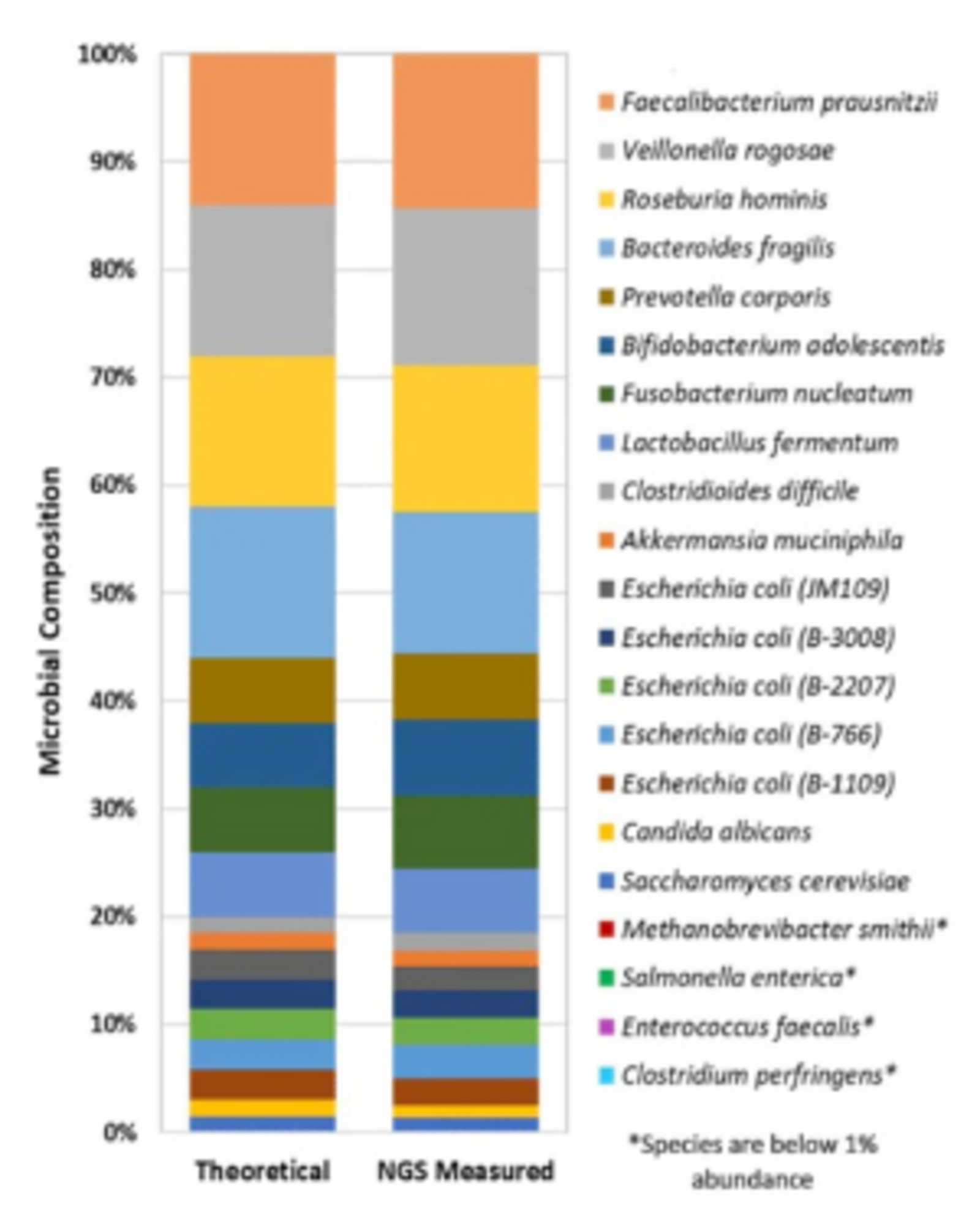
Figure 1. The microbial composition of the standard measured by NGS shotgun sequencing as compared to the defined composition.
The microbial composition of the standard was confirmed using Illumina® shotgun sequencing. Genomic DNA was extracted using the ZymoBIOMIC® DNA Miniprep Kit. Library preparation was performed using an in-house protocol. Shotgun sequencing was performed using Illumina MiSeq™. Microbial abundance was estimated based on the number of reads that were mapped to references genomes of the organisms.